Be yourself; Everyone else is already taken.
— Oscar Wilde.
This is the first post on my new blog. I’m just getting this new blog going, so stay tuned for more. Subscribe below to get notified when I post new updates.
Be yourself; Everyone else is already taken.
— Oscar Wilde.
This is the first post on my new blog. I’m just getting this new blog going, so stay tuned for more. Subscribe below to get notified when I post new updates.
Blues is a music genre[3] and musical form which was originated in the Deep South of the United States around the 1870s by African-Americans from roots in African musical traditions, African-American work songs, and spirituals. Blues incorporated spirituals, work songs, field hollers, shouts, chants, and rhymed simple narrative ballads.[2] The blues form, ubiquitous in jazz, rhythm and blues and rock and roll, is characterized by the call-and-response pattern, the blues scale and specific chord progressions, of which the twelve-bar blues is the most common. Blue notes (or “worried notes”), usually thirds, fifths or sevenths flattened in pitch are also an essential part of the sound. Blues shuffles or walking bass reinforce the trance-like rhythm and form a repetitive effect known as the groove.
Blues as a genre is also characterized by its lyrics, bass lines, and instrumentation. Early traditional blues verses consisted of a single line repeated four times. It was only in the first decades of the 20th century that the most common current structure became standard: the AAB pattern, consisting of a line sung over the four first bars, its repetition over the next four, and then a longer concluding line over the last bars. Early blues frequently took the form of a loose narrative, often relating the racial discrimination and other challenges experienced by African-Americans.
Many elements, such as the call-and-response format and the use of blue notes, can be traced back to the music of Africa. The origins of the blues are also closely related to the religious music of the Afro-American community, the spirituals. The first appearance of the blues is often dated to after the ending of slavery and, later, the development of juke joints. It is associated with the newly acquired freedom of the former slaves. Chroniclers began to report about blues music at the dawn of the 20th century. The first publication of blues sheet music was in 1908. Blues has since evolved from unaccompanied vocal music and oral traditions of slaves into a wide variety of styles and subgenres. Blues subgenres include country blues, such as Delta blues and Piedmont blues, as well as urban blues styles such as Chicago blues and West Coast blues. World War II marked the transition from acoustic to electric blues and the progressive opening of blues music to a wider audience, especially white listeners. In the 1960s and 1970s, a hybrid form called blues rock developed, which blended blues styles with rock music.
Blues as a genre is also characterized by its lyrics, bass lines, and instrumentation. Early traditional blues verses consisted of a single line repeated four times. It was only in the first decades of the 20th century that the most common current structure became standard: the AAB pattern, consisting of a line sung over the four first bars, its repetition over the next four, and then a longer concluding line over the last bars. Early blues frequently took the form of a loose narrative, often relating the racial discrimination and other challenges experienced by African-Americans.
Many elements, such as the call-and-response format and the use of blue notes, can be traced back to the music of Africa. The origins of the blues are also closely related to the religious music of the Afro-American community, the spirituals. The first appearance of the blues is often dated to after the ending of slavery and, later, the development of juke joints. It is associated with the newly acquired freedom of the former slaves. Chroniclers began to report about blues music at the dawn of the 20th century. The first publication of blues sheet music was in 1908. Blues has since evolved from unaccompanied vocal music and oral traditions of slaves into a wide variety of styles and subgenres. Blues subgenres include country blues, such as Delta blues and Piedmont blues, as well as urban blues styles such as Chicago blues and West Coast blues. World War II marked the transition from acoustic to electric blues and the progressive opening of blues music to a wider audience, especially white listeners. In the 1960s and 1970s, a hybrid form called blues rock developed, which blended blues styles with rock music.
This article is about Western art music to the present. For Western art music from 1750 to 1820, see Classical period (music). For other “classical” and art music traditions, see List of classical and art music traditions. For the magazine, see Classical Music (magazine).
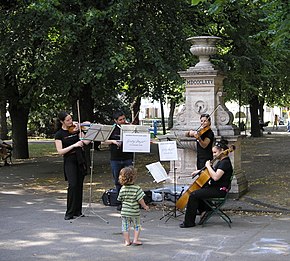
Classical music is art music produced or rooted in the traditions of Western culture, including both liturgical (religious) and secular music. While a more precise term is also used to refer to the period from 1750 to 1820 (the Classical period), this article is about the broad span of time from before the 6th century AD to the present day, which includes the Classical period and various other periods.[1] The central norms of this tradition became codified between 1550 and 1900, which is known as the common-practice period.
Instrumentation and vocal practices
The instruments currently used in most classical music were largely invented before the mid-19th century (often much earlier) and systematized in the 18th and 19th centuries. They consist of the instruments found in an orchestra or in a concert band, together with several other solo instruments (such as the piano, harpsichord, and organ). The symphony orchestra includes members of the string, woodwind, brass, and percussion families of instruments. The concert band consists of members of the woodwind, brass, and percussion families. It generally has a larger variety and number of woodwind and brass instruments than the orchestra but does not have a string section. However, many concert bands use a double bass. The vocal practices changed over the classical period, from the single line monophonic Gregorian chant done by monks in the Medieval period to the complex, polyphonic choral works of the Renaissance and subsequent periods, which used multiple independent vocal melodies at the same time.
This is an example post, originally published as part of Blogging University. Enroll in one of our ten programs, and start your blog right.
You’re going to publish a post today. Don’t worry about how your blog looks. Don’t worry if you haven’t given it a name yet, or you’re feeling overwhelmed. Just click the “New Post” button, and tell us why you’re here.
Why do this?
The post can be short or long, a personal intro to your life or a bloggy mission statement, a manifesto for the future or a simple outline of your the types of things you hope to publish.
To help you get started, here are a few questions:
You’re not locked into any of this; one of the wonderful things about blogs is how they constantly evolve as we learn, grow, and interact with one another — but it’s good to know where and why you started, and articulating your goals may just give you a few other post ideas.
Can’t think how to get started? Just write the first thing that pops into your head. Anne Lamott, author of a book on writing we love, says that you need to give yourself permission to write a “crappy first draft”. Anne makes a great point — just start writing, and worry about editing it later.
When you’re ready to publish, give your post three to five tags that describe your blog’s focus — writing, photography, fiction, parenting, food, cars, movies, sports, whatever. These tags will help others who care about your topics find you in the Reader. Make sure one of the tags is “zerotohero,” so other new bloggers can find you, too.

 Crane's blog